Serving Fort Wayne, Allen County, IN and surrounding areas
Foundation Repair in Fort Wayne, IN
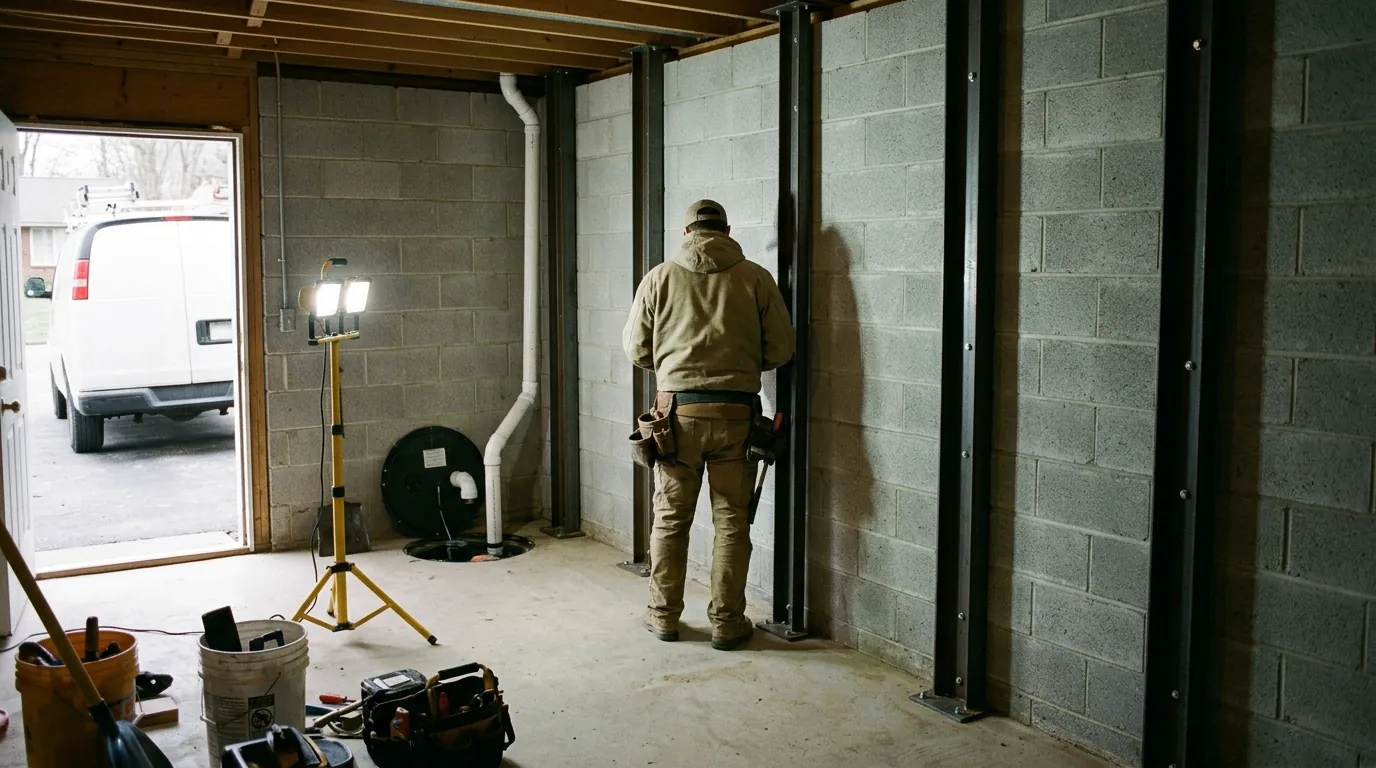
Cracked and bowed basement walls braced, settling footings carried on steel piers, wet basements drained, sump pumps installed, sunken slabs lifted and crawl spaces dried out. Every job starts with a free foundation inspection that finds the cause first.
Sealing one leaking crack typically runs $400 to $900. Bracing a wall or underpinning a footing costs more. See typical Fort Wayne prices or text photos to (260) 205-8668.
Fig. 1 What are you seeing? Pick one.
- Work
- Foundation repair and basement waterproofing
- Primary coverage
- Fort Wayne and Allen County
- First step
- Free foundation inspection
- Pricing
- Written proposal after the inspection
- Warranty
- Terms stated in the written proposal
Typical prices
How much does foundation repair cost in Fort Wayne?
Foundation work is priced by the unit, and the unit depends on the repair: per crack for injection, per strap, beam or anchor for a bowed wall, per pier for a settling footing, per linear foot for drain tile. That is why a phone quote is close to useless. Nobody knows how many units a house needs until someone has measured the wall and walked the outside.
Four things push a job toward the top of its range. A finished basement means drywall and framing come off before the wall can be reached, and go back after. Tight access, such as a narrow side yard, a deck or mature landscaping over the dig, slows every exterior step. Depth matters for piers, since each one is driven until it reaches soil that holds, and that depth varies across one lot. And exterior excavation, when the job truly needs it, can triple the cost of doing the same work from inside.
Cost also runs the other way. A good share of inspections end with a recommendation to extend two downspouts, regrade one flower bed and watch a crack for a season. For the line-by-line breakdown on structural work, see foundation crack and wall repair pricing in Fort Wayne.
| Work | Typical range | What it covers |
|---|---|---|
| Foundation inspection | Free | Outside grade and downspouts, crack widths, wall plumb, floor slope, written findings |
| Crack injection, epoxy or polyurethane | $400 – $900 per crack | Poured concrete walls. Ports, surface seal and injection through the full wall thickness |
| Carbon fiber wall straps | $450 – $1,000 per strap | Bowed walls that have moved less than about 2 inches. Most walls take 6 to 10 |
| Steel beam braces or wall anchors | $700 – $1,300 each | Larger bows. Spaced along the wall, fixed at the floor and the framing above |
| Push piers or helical piers | $1,500 – $3,000 per pier | Settling footings. Most jobs take 4 to 10 piers |
| Interior drain tile waterproofing | $60 – $120 per linear ft | Trench, perforated pipe in washed stone, wall liner, new concrete over the top |
| Sump pump, new pit and pump | $1,200 – $2,500 | Basin, pump, check valve and discharge line. A battery backup is extra |
| Concrete leveling | $3 – $16 per sq ft | Mudjacking at the low end, polyurethane foam at the high end |
| Crawl space encapsulation | $3,500 – $9,000 | Liner on the ground and walls, sealed vents, dehumidifier |
Ranges are typical figures for this kind of work and are not a quote or a fixed menu. Your price comes in a written proposal after the inspection, with the unit count and the warranty terms spelled out.
Text a photo
Tell us what you are seeing in one tap.
Pick the closest match and your messages app opens with it filled in. Add your town, attach a photo of the crack or the wet spot with something for scale, and press send. Nothing is stored on this site.
A photo with a coin or a tape measure beside the crack is enough to start.
The free inspection
What happens during a foundation inspection in Fort Wayne?
The outside comes first, because most of what goes wrong with a foundation starts with where the rain goes. The inside confirms it. A foundation inspection that begins in the basement with a brochure has skipped the half that explains the cause.
- Walk the outside. Where each downspout empties, which way the soil slopes in the first ten feet, whether a walk or patio has tipped toward the house, and whether brick or siding shows stair-step cracks or gaps at the window frames.
- Measure the walls. A level and a tape on each basement wall to find any inward bow, and how much. Crack widths are measured and the ends marked so movement can be checked later.
- Check the floors. A level across the basement slab and the main floor above shows whether a corner is dropping, and by how much over what distance.
- Look for water. Stains at the joint where the floor meets the wall, white mineral powder on block, rust on the furnace feet, and the condition of the sump pit if there is one.
- Explain the cause. You are shown what was found and what is causing it, including the parts that need no contractor at all.
- Write it down. A written proposal lists the repair, the unit count, the total, the payment schedule and the warranty terms. Nothing has to be signed that day.
A contractor's inspection and an engineer's report are different things. For a large structural job, or when a home sale depends on the answer, an independent structural engineer charges a fee and sells no repairs. Bringing one in is reasonable and no good contractor objects to it.
Services
What foundation repair and waterproofing services can you get in Fort Wayne?
Prices shown are typical ranges, to be confirmed in a written proposal. Not sure which page fits what you are seeing? Text a photo and you will be pointed to the right one.
Foundation repair or basement waterproofing?
They are two trades that share a basement. Foundation repair deals with movement: a wall bowing in, a footing sinking, a crack that keeps growing. Waterproofing deals with water: where it gets in and where it is sent. One often causes the other, since saturated clay is what pushes on a wall, so a proposal that braces the wall and ignores the downspout beside it has done half the job.
When no repair is needed
Thin vertical cracks in a poured wall that stay dry. A sump pump that runs often in April and rests in August. A hairline crack across a basement floor. These are normal in Allen County houses, and the right advice is to mark them, date them and look again in six months.
Clay, frost and three rivers
Why do foundations crack and basements leak in Fort Wayne?
Clay holds water. A sandy soil lets rain pass down and away. Clay soaks it up slowly and swells, then gives it back slowly and shrinks. The soil shoveled back against a foundation after it was built is looser than the ground around it, so it takes on even more water. A basement wall is a retaining wall holding that wet soil back, and it was built to carry the house down, not to resist a sideways push.
Winter adds to it. Water in the top few feet of soil freezes and expands against the upper part of the wall, which is why block walls so often crack along a mortar joint partway up and lean in above it. Each thaw lets the soil settle back a little differently than it sat before.
Then there is the water table. Fort Wayne sits where the St. Marys and St. Joseph rivers meet to form the Maumee. Lots on low ground near any of the three can have groundwater within a few feet of the basement floor in a wet spring. That water does not come through the wall. It rises under the slab and shows up at the joint where the floor meets the wall.
Dry spells do damage as well. In a long dry summer the clay shrinks away from the footing, usually unevenly, and the corner with the big tree or the south-facing wall drops first. That shows up as doors that stick upstairs and a stair-step crack in the brick.
| Symptom | Usual cause | Usual fix | Often no repair needed? |
|---|---|---|---|
| Thin vertical crack, poured wall | Shrinkage as the concrete cured | Inject only if it leaks | Yes, if dry and not widening |
| Horizontal crack, block wall | Wet clay and frost pushing on the wall | Straps, beams or anchors, plus drainage | No, have it measured |
| Stair-step crack, doors sticking | One part of the footing settling | Piers under the settled section | Sometimes, if it has stopped moving |
| Water where the floor meets the wall | Groundwater rising under the slab | Interior drain tile and a sump pump | No, if it returns each wet season |
| Water at one corner after a storm | Downspout or grading | Extend the downspout, regrade | Yes, no contractor required |
| Walk or driveway tipped toward the house | Backfill settling, soil washed out | Concrete leveling | Sometimes, if under half an inch |
| Bouncy floor, musty smell | Damp crawl space, undersized supports | Vapor barrier or encapsulation, added posts | Rarely |
Coverage
Which parts of the Fort Wayne area do you cover?
Serving Fort Wayne, Allen County, IN and surrounding areas. Every job starts with a visit to the house, so the first question on the phone is which town you are in.
- Central Fort WayneThe older neighborhoods around the meeting of the three rivers, where many basements are block or stone and sit on low ground.
- North sideOut toward the I-69 interchanges and on to Huntertown, with a mix of older basements and newer subdivisions on graded fill.
- Southwest and AboiteInside and just outside the I-69 and I-469 junction, mostly poured-wall basements from the last few decades.
- South side and WaynedaleRanch houses and crawl spaces on clay lots, toward the southern arc of I-469.
- New HavenEast along US-30 and the Maumee River, inside the I-469 loop.
- Leo-CedarvilleNortheast along the St. Joseph River valley.
- AuburnNorth on I-69 in DeKalb County.
- Columbia CityWest along US-30. Call to confirm scheduling this far out.
Hiring a contractor
How do you compare foundation repair contractors in Fort Wayne?
Two foundation repair companies can look at the same wall and come back thousands of dollars apart, and both can be honest. One has priced six carbon fiber straps. The other has priced steel beams, a full run of drain tile and a sump pump. The only way to compare them is to line up what each proposal says the cause is and what it does about it.
In the proposal
The cause in plain words, the repair method, the count of piers, straps, beams or feet of drain, the total price, what could change it, the payment schedule, and the warranty terms including whether they transfer to a buyer.
Before you sign
Ask for a certificate of insurance and any contractor registration your municipality requires, and check both yourself. Ask who does the work, the company's crew or a subcontractor, and who pulls the permit if one is needed.
Things worth walking away from: a price that is only good today, a refusal to leave the numbers in writing, a pitch that opens with the most expensive option, and a warranty nobody will show you before you pay. A large deposit before any material is on site is another. Pressure is a sales method. A wall that took thirty years to bow one inch will not fail this weekend, and you have time to get a second opinion.
One more test. Ask what happens if you do nothing for a year. A straight answer, including "probably nothing, but mark the crack and check it in spring," tells you more about a contractor than the brochure does. The step-by-step repair methods are on the basement waterproofing in Fort Wayne and sump pump installation and drainage pages.
Questions
What else do Fort Wayne homeowners ask about foundation repair?
Is there foundation repair near me if I live outside Fort Wayne?
Yes. The same inspections and repairs are done across Allen County, including New Haven, Huntertown, Leo-Cedarville, Aboite and Waynedale, and north to Auburn in DeKalb County. Say which town the house is in when you call so the visit can be scheduled with others nearby.
Does every foundation crack need to be repaired?
No. Thin vertical cracks in a poured concrete wall are usually shrinkage from curing and need sealing only if they leak. Horizontal cracks, stair-step cracks in block, cracks wider than a quarter inch and any crack that is growing should be inspected. Mark the ends with a pencil and a date to see whether it moves.
How long does foundation repair take?
Crack injection takes an hour or two per crack. Carbon fiber straps or steel beams on one wall are usually a one or two day job. Piers take two to five days depending on the count and the digging. Interior drain tile around a full basement typically takes two to four days.
Does homeowners insurance cover foundation repair?
Usually not. Most policies exclude settling, soil movement and groundwater seepage, which are the common causes. Damage from a sudden covered event, such as a burst pipe, may be treated differently, and sump pump backup is often a separate add-on. Read your own policy and ask your agent before assuming either way.
Can foundation repair be done in winter in Fort Wayne?
Most of it can. Interior work such as crack injection, carbon fiber straps, steel beams, drain tile and sump pumps goes on all year. Piers and wall anchors need digging, which is slower in frozen ground but still done in most winters. Concrete leveling outdoors waits for the frost to leave the ground.
Related services: concrete leveling in Fort Wayne and crawl space repair and waterproofing in Fort Wayne.
Seeing a crack, a leak or a sloping floor?
(260) 205-8668Tell us what you are seeing and which town the house is in. A free foundation inspection comes first, then a written proposal that names the cause, the repair, the price and the warranty terms. Prefer not to talk? Text photos of the crack or the wet spot.